


Two recently published papers shed new light on the agricultural practices, foodways, and plant management strategies of Roman Iesso, one of the few sites in the Iberian Peninsula with exceptional, waterlogged, preservation of plant remains, opening up new windows into Roman economy and tastes.
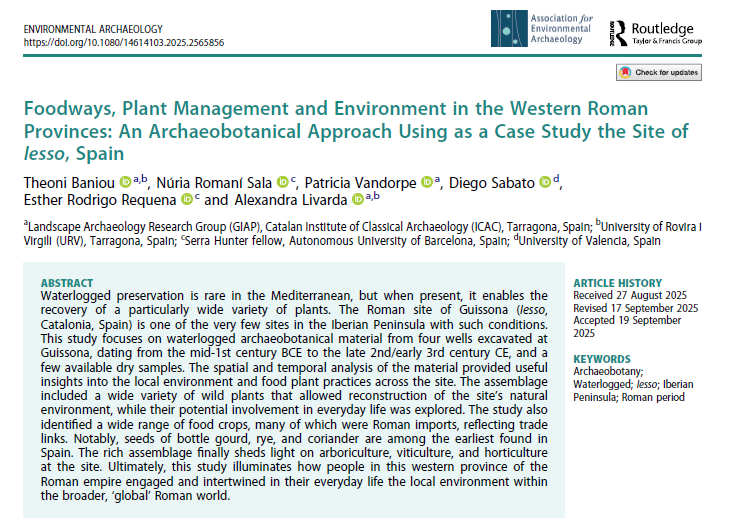
The first paper, published in Environmental Archaeology by Theoni Baniou, Núria Romaní Sala, Patricia Vandorpe, Diego Sabato, Esther Rodrigo Requena and Alexandra Livarda, titled “Foodways, Plant Management and Environment in the Western Roman Provinces: An Archaeobotanical Approach Using as a Case Study the Site of Iesso, Spain”, offers a comprehensive archaeobotanical exploration of daily life, agricultural choices, and environmental interactions in the western Roman provinces.
You can access the paper at: https://doi.org/10.1080/14614103.2025.2565856
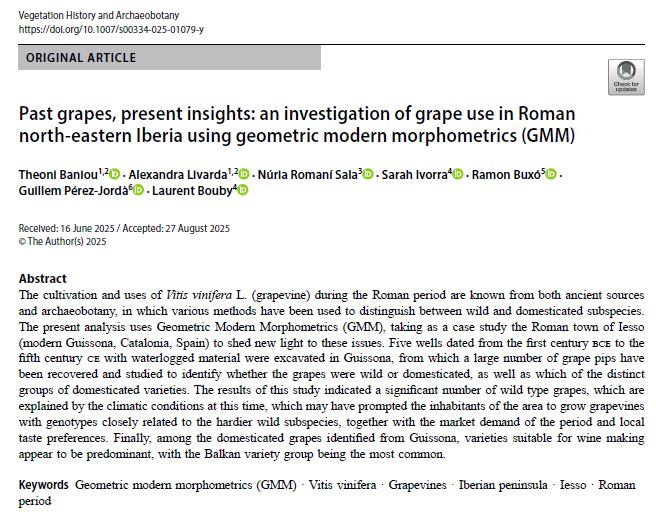
A second study, now published in Vegetation History and Archaeobotany, focuses on grape cultivation and use across several centuries of Roman occupation at Iesso. “Past grapes, present insights: an investigation of grape use in Roman north-eastern Iberia using geometric modern morphometrics (GMM)” by Theoni Baniou, Alexandra Livarda, Núria Romaní Sala, Sarah Ivorra, Ramon Buxó, Guillem Pérez-Jordà and Laurent Bouby applies Geometric Modern Morphometrics to waterlogged grape pips recovered from five wells dated between the 1st century BCE and the 5th century CE, offering new perspectives on viticulture and consumption practices.
The paper is freely available at: https://doi.org/10.1007/s00334-025-01079-y
Funding information: Both studies were supported by a range of institutional and project-based funding. For the grape GMM research, Open Access was provided through the CRUE‑CSIC agreement with Springer Nature; Theoni Baniou’s work was funded by the Institut Català d’Arqueologia Clàssica (ICAC, CIN21 (26.59)), while Laurent Bouby and Sarah Ivorra received support from the Agence Nationale de la Recherche (ANR- 22-CE27-0026). The excavation of the last three wells at Iesso and the recovery of the archaeobotanical material formed part of the Quadrennial Archaeological Project 2022–2025 funded by the Departament de Cultura de la Generalitat de Catalunya and the Guissona City Council, with additional support from the GIAP‑ICAC archaeobotany group led by Dr Livarda. The archaeobotanical study was funded by the Catalan Institute of Classical Archaeology (ICAC, CIN21 (26.59)), the Quadrennial Archaeological Projects 2014–2017, 2018–2021 and 2022–2025, the Guissona City Council and the Institute for Catalan Studies, alongside support from the GIAP‑ICAC archaeobotany group.


